|
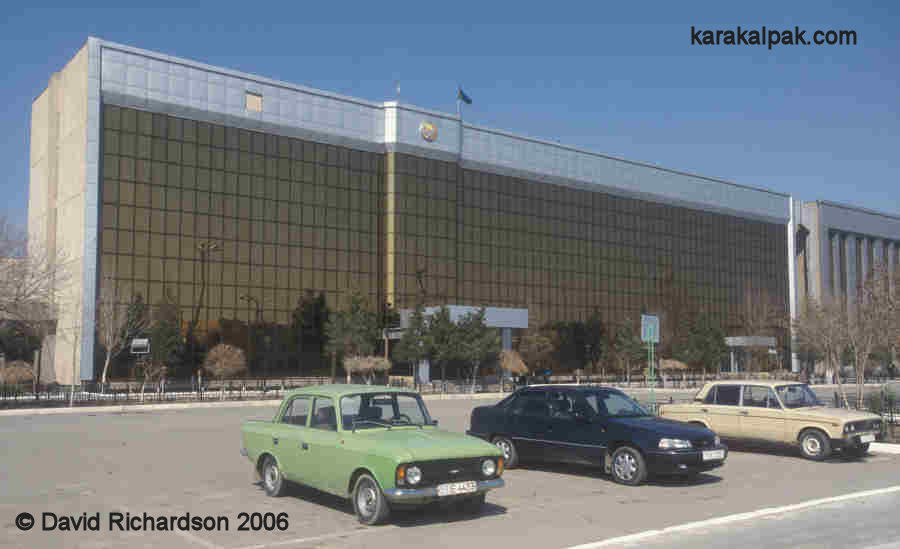
The former home of the Joqarg'ı Ken'es in the heart of No'kis. It now houses the Council of Ministers.
Under the new 1992 Constitution of Uzbekistan the Republic of Karakalpakstan was established as an integral part of
Uzbekistan with its sovereignty protected by the Republic of Uzbekistan. The Republic of Karakalpakstan has an
autonomous status and is guaranteed its own constitution. In principal it is free to make independent decisions about
its own administrative structure. Indeed, under that same Constitution, Karakalpakstan even has the right to secede from
Uzbekistan, subject only to the outcome of a universal referendum of its own people. The Constitution also guarantees
cultural rights and confers official status on the Karakalpak language, the only other language officially sanctioned
in addition to Uzbek.
Despite this autonomous status, under the Constitution the laws of Uzbekistan apply equally to the territory of
Karakalpakstan and the territory and boundaries of Karakalpakstan cannot be altered without the agreement of Uzbekistan.
The separate Constitution of the Republic of Karakalpakstan was adopted on 9 April 1993 and further defines its administrative
structure. Government authority is separated between the executive and the judiciary. The Joqarg'ı Ken'es or Supreme
Council is the highest representative legislative body, while the Council of Ministers is the highest executive body. The
chairperson of the Joqarg'ı Ken'es is responsible for proposing a candidate for the head of the Council of Ministers,
although this proposal must have the approval of the President of Uzbekistan.
In reality Karakalpakstan is little more than another province of Uzbekistan, albeit the largest and with its own unique
status and administrative procedures. Authority essentially resides with Islam Abdughanivich Karimov, who has been the
President of the Republic of Uzbekistan since its creation in 1991 and is secure in his present position until December 2014.
Neither the Council of Ministers nor the Joqarg'ı Ken'es plays any real independent role other than rubber-stamping
and implementing Presidential decrees. Karakalpakstan essentially complies with all of the standards, rules, taxes, and price
controls established by the legislative assembly or Oliy Majlis in Tashkent.
The concept of Karakalpak secession is not only inconceivable from a political perspective but also from one of
practicality. Karakalpakstan is an artificial state and is not independently viable. It is economically weak, has no military
forces of its own, has serious environmental liabilities and, thanks to the former Soviet system, has virtually no capital
resources of its own. However the whole of the Khorezm oasis probably could be economically viable.
In practice the laws of Karakalpakstan are virtually identical to the laws of Uzbekistan with only minor differences.
Karakalpakstan has two Supreme Courts, one for civil and one for criminal affairs, along with an Economic Court.
The current President of Uzbekistan, Islam Karimov, was appointed First Secretary of the Central Committee of the Communist
Party of Uzbekistan by President Gorbachëv in June 1989 in a move designed to make a break with the past, ousting the
entrenched and reform-resistant regime that had been tainted by the Rashidov cotton scandal. In March 1990 Karimov was
appointed to the newly created post of President, introduced Union-wide as a means of increasing the status of all of the Soviet
States. After the collapse of the coup against Gorbachëv, and the early stages of the dissolution of the USSR, Islam Karimov
followed the lead of Estonia, Latvia, Russia, the Ukraine, and Belarus, declaring the independence of Uzbekistan on 31 August 1991.
Meanwhile in Karakalpakstan Da'wletbay Shamshetov had only been appointed Chairman of the Karakalpak Supreme Soviet in
January 1991. He was appointed as the first President of Karakalpakstan in November 1991. However, once firmly established
in power, Karimov felt confident to install his own Presidential appointee and in May 1992 he ousted Shamshetov in favour
of U'bbiniyaz Ashirbekov. Ashirbekov became the first Chairman of the Joqarg'ı Ken'es under the new Constitution.
However the economic impact of independence on Karakalpakstan was particularly negative and by July 1997, after three bad
years of economic and agricultural decline, Karimov had had enough of his protégé. He travelled to Karakalpakstan and at an
extraordinary session of the Joqarg'ı Ken'es he accused the local leadership of creating a gigantic cash deficit.
Ashirbekov was sacked and replaced by Timur Kamalovich Kamalov.
Kamalov proved popular with local people and was responsible for numerous modernization projects, including the upgrading of
the Karakalpak road system and the construction of the new No'kis airport. Five years on however and events began to repeat
themselves. Karakalpakstan suffered from two major droughts in 2000 and 2001, which together had a devastating impact on the
local cotton crop and on agriculture in general. Once again President Karimov visited No'kis and criticized local officials
for continuing to use the Aral Sea crisis as an excuse for regional underperformance. He accepted the resignation of Timur
Kamalov and proposed the appointment of Musa Tajetdinovich Erniyazov as Chairman of the Joqarg'ı Ken'es, who was
duly voted into office. 58-year-old Erniyazov was the former chief of Karakalpakstan's construction and communications
sectors.
|
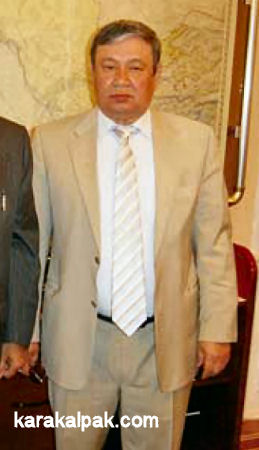
Musa Erniyazov, the current President of Karakalpakstan.
On 27 January 2005 Erniyazov was elected a Deputy Chairman of the Oliy Majlis of Uzbekistan.
The current Chairman of the Council of Ministers, effectively the Prime Minister, is Baxodir Yangibaev who was formerly the
Finance Minister of Karakalpakstan. He was only appointed at the beginning of March 2006, replacing former Prime Minister
Tursınbay Tangirbergenov who was relieved of his duties. Before becoming Chairman of the Council of Ministers, Tangirbergenov
had been the ha'kim or governor of To'rtku'l. The Chairman of the Council of Ministers automatically becomes a member of
the Council of Ministers of the Republic of Uzbekistan.
On 22 February 2007 the official Uzbekistan government website announced a brief report on a recent session of the Joqarg'ı Ken'es
chaired by Musa Erniyazov, which reviewed the social and economic development in 2006. Growth in the production output of Karakalpakstan
was reported to be 6.3% higher than in 2005, implying a stagnant economy given the overall inflation rate of 6.8% for the year. Only 2.5% of
the total 554 billion Uzbek soum output was generated by joint ventures. Erniyazov criticized a number of local companies for
their slow pace of modernization and lack of foreign investment.
Karakalpakstan is divided up into 15 administrative districts, known as tumans, and 12 cities. These are headed by
ha'kims who act as both regional or city executives and as the heads of their local councils. They must be nominated
by the Council of Ministers and are approved by the Joqarg'ı Ken'es.
The 15 Karakalpak regional districts are as follows:
| Tuman | Administrative Centre |
| Amu Darya | Man'g'ıt |
| Biruniy | Biruniy |
| Bozataw | Qazanketken |
| Qanliko'l | Qanlıko'l |
| Qarao'zek | Qarao'zek |
| Kegeyli | Kegeyli |
| Qon'ırat | Qon'ırat |
| Moynaq | Moynaq |
| No'kis | Aq Man'g'ıt |
| Taxta Ko'pir | Taxta Ko'pir |
| To'rtku'l | To'rtku'l |
| Xojeli | Xojeli |
| Shımbay | Shımbay |
| Shomanay | Shomanay |
| Ellikqala | Bostan |
The 12 cities are: Biruniy, Bostan, Qon'ırat, Man'g'ıt, Moynaq, Taxta Ko'pir, To'rtku'l, Xalqabad, Xojeli, Shımbay,
Shomanay and of course No'kis. The Governor or Ha'kim of No'kis is Jalgas Berdixanov, who is also a deputy of the Joqarg'ı Ken'es.
In addition there are 16 towns and 112 villages or awıls.
Self government at a neighbourhood level is carried out through local citizens committees known in Karakalpakstan as
ma'ka'n-ken'es. They are identical to the mahalla committeees that operate throughout the rest of Uzbekistan.
Pronunciation of Karakalpak Terms
To listen to a Karakalpak pronounce any of the following words just click on the one you wish to hear. Please note that the dotless letter
'i' (ı) is pronounced 'uh'.
Visit our sister site www.qaraqalpaq.com, which uses the correct transliteration, Qaraqalpaq, rather than the
Russian transliteration, Karakalpak.
Return to top of page
Home Page
|
|