The Karakalpak Yurt Door
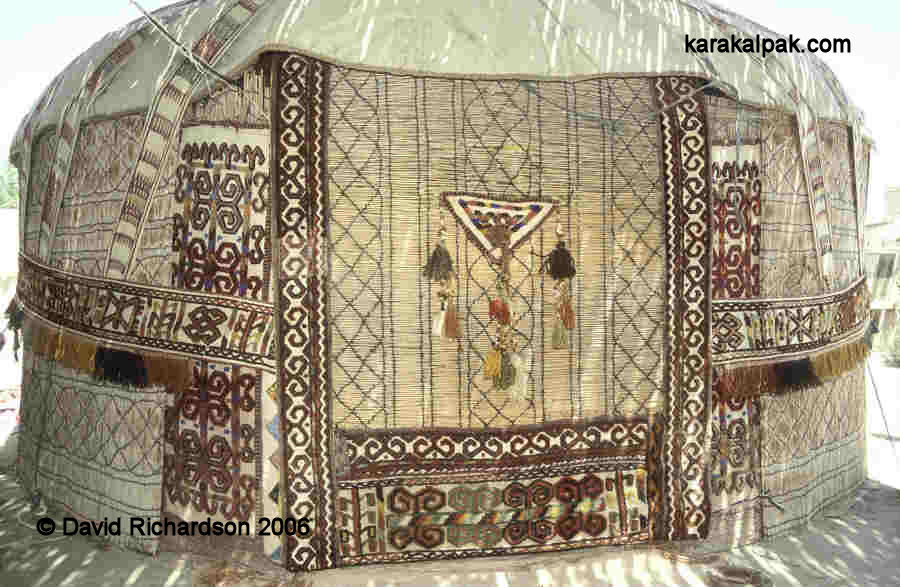
A beautifully decorated yurt door from Moynaq.
This yurt won the annual town competition for the best yurt of 2004.
The external decoration of the Karakalpak yurt is designed around the entrance door, creating a welcoming atmosphere to both owner and guests alike.
The doorway of the yurt is made up of various parts which can be easily dismantled, typical of all Turkic yurts. The entire
doorway is known as the ergenek and this name is also used specifically for the pair of hinged wooden doors which
fold inwards. The upright struts, or door jambs, are known as the tulg'a. The threshold is the bosag'a and
the lintel is the man'laysha (from man'lay, forehead).
The doors of Karakalpak yurts were often plain and undecorated. Carving and in particular painting of the doors in bright
colours became more popular in the 1940s and 1950s. In the 1920s and 1930s this had been considered to be a ‘Qazaq taste’.
According to Savitsky some craftsmen preferred to use Amu Darya willow (Salix oxica, known locally as sog'ıt),
or pine (qarag'ay) for the door panels. According to our research sog'ıt was indeed used for door panels
but its botanical name is Salix alba. Salix oxica is in fact aq tal. It also seems strange that he refers
to the use of pine, as both pine and birch (qayın') are generally considered by Karakalpaks to bring misfortune and sterility.
In addition to the inner pair of wooden doors the yurt also has an outer roll-up door called an esik. This is
fastened to the uwıqs (poles linking the kerege and the roof-wheel thereby forming the roof of the yurt)
above the man'laysha with the aid of three ropes which are sewn to its upper edges. It is rectangular in shape
and is slightly larger than the ergenek and tulg'a so that when it is rolled down all of the gaps are
covered. It is made of a reed screen sewn onto a base of felt or other thick material.
|
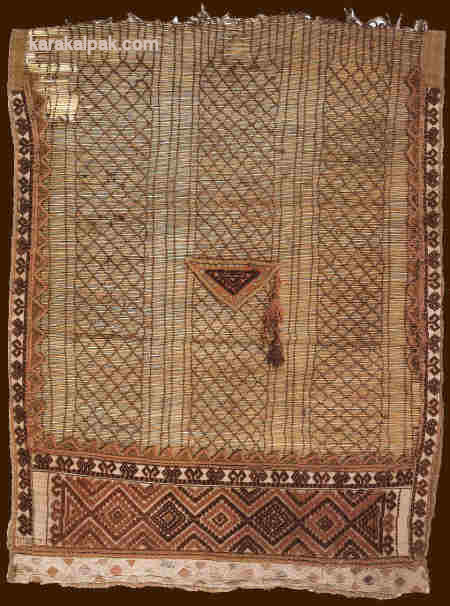
An early 20th century Karakalpak esik with a duwashıq amulet and a lower suwag'ar.
Item 8762-23901 from the collection of the Russian Ethnography Museum.
Esiks are ornamented in a traditional way with vertical strips in appliqué or combination technique sewn onto
the sides. These are known as shiyqayıw. Another horizontal strip is sewn onto the bottom of the esik
overlapping the shiyqayıw, designed to prevent the ingress of water. This is known as the suwag'ar.
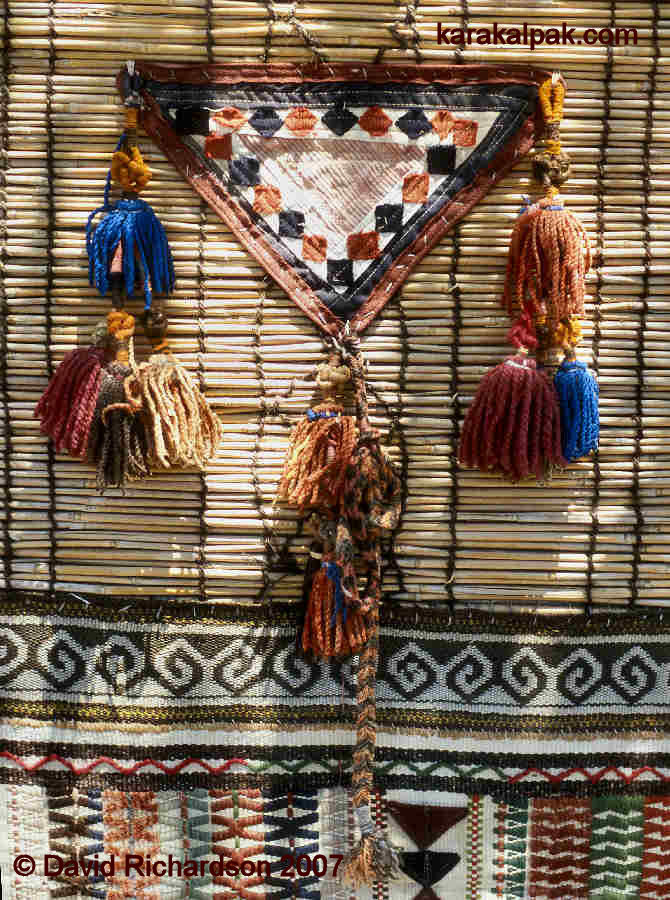
In the centre of the esik is sewn the duwashıq.
The duwashıq on an esik or outer door of a yurt in one of the northern suburbs of No'kis.
This is made from material in the form of a triangle with the point facing downwards. It generally has tassels at each of the
corners. The shape of this triangle calls to mind the tumar amulet and it is connected with pre-Islamic beliefs. Similar
protective triangles can be seen on the back of men’s postın coats, and on children’s clothing. In the past pieces
of paper with verses from the Qu'ran were sometimes put into a pocket in the duwashıq, thereby fulfilling a similar
role to the ha'ykel worn by girls and women.
Pronunciation of Karakalpak Terms
To listen to a Karakalpak pronounce any of the following words just click on the one you wish to hear. Please note that the dotless letter
'i' (ı) is pronounced 'uh'.
Visit our sister site www.qaraqalpaq.com, which uses the correct transliteration, Qaraqalpaq, rather than the
Russian transliteration, Karakalpak.
Return to top of page
Next Page: Inside the Yurt
Home Page
|